A Broken Heart
The sacrament is less about what we get, and more about what we give — ourselves; and in the giving, we are made whole.
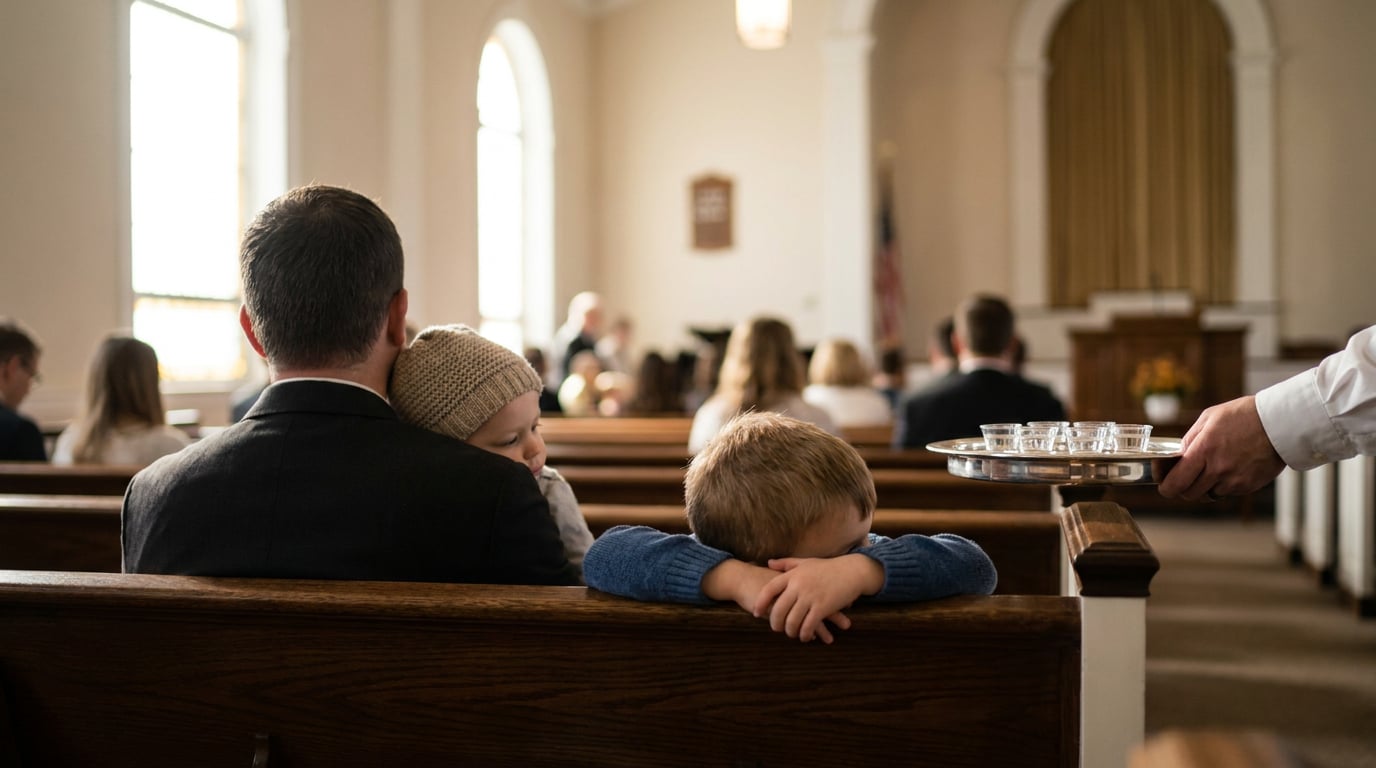
A few weeks ago we were getting ready to take the sacrament. I had my two-year-old on one knee, whining that he wanted snacks. My four-year-old asking to color. My six-year-old begging me to let him go sit with his friends a few rows back. The tray was coming down the row, and I caught myself thinking: This is the most sacred moment of my week — and I’m just managing chaos.
Some of you know that feeling. For some of us the noise is three kids. For some it is a quiet bench and a heavy week. Either way, it is easy to feel like we have already failed at preparing.
The next day, in family home evening, we talked about how to make the sacrament more meaningful. We talked about wanting to remember Jesus — and wanting to give Him something. A gift. So we made one small decision. We would not open the church bag until after the sacrament. We would try to listen quietly and fold our arms while the bread and water passed.
That was it. No big speech. One honest plan.
It made a real difference. The kids are still kids. The madness still comes. It just waits until after.
That is when I started to see it differently. We were not trying to look ready. We were trying to have something ready to give.
The Lord asks us to come to the sacrament with “a broken heart and a contrite spirit.”1 I have spent a lot of Sundays wondering if mine was ready yet.
Then I sat with Elder Holland’s words. He said Christ “died from a heart broken by shouldering entirely alone the sins and sorrows of the whole human family.”2
That changes the picture for me. The broken heart is not something we bring to a God who does not understand. His heart was broken first — completely, alone — so that ours could be healed.
And then He asks us for the same thing: offer Him a broken heart and a contrite spirit. Not a perfect heart. A broken one — offered.
He is not asking us to go break our hearts. He is asking us to trust Him enough to come with the ones we already have.
A broken heart is not only a hurting heart. It is a heart opened to God — a heart willing to repent, surrender, and be changed.
God does not glue the old heart back together and hand it back. He replaces it. “A new heart also will I give you.”3
So the sacrament is the sacred part of our week when we do not have to pretend we are whole. We come with what is actually broken. And that is the offering He asked for.
Paul said, “Let a man examine himself.”4 We do not have to be perfect to come. We come to be made clean. But we do have to come with a heart willing to be worked on.
In the temple recommend interview, the Church asks us about this. One of the questions is whether we prepare for and worthily partake of the sacrament.
That phrase catches my attention: prepare for. Not just show up. Prepare.
For a long time I heard “worthily” as cleaned up — as if I had to get myself in order before I was allowed to come. But if the offering is a broken heart, then prepare does not mean arrive perfect. It means arrive willing to offer.
I used to come mostly thinking about what I would get. Peace. Forgiveness. A fresh start. Those things are real. The covenants we renew are real. The blessings that come with them are real. We do receive them. But the Lord also uses a different word. He says, “offer up thy sacraments upon my holy day.”5
Offer up.
That is the distinction I keep coming back to. We come to receive His gift. And we come to offer our own. And in the giving, we are made whole.
Preparing also means being there. Settled. Ready. And this is the harder one for me.
With three small children, Sunday morning is a battle. Getting there on time is genuinely hard. For a long time I told myself, If I’m late, at least I’m here. I can still get what I need.
But if the sacrament is an offering, that line does not hold up for me anymore. When I arrive rushed or late, I lose some of the opportunity to prepare my offering. I want to arrive ready — not so I get more out of it, even though I will — but because I love the One I am giving it to. I do not want to arrive late to something this sacred.
Elder Holland said it better than I can:
“A late pass will always be lovingly granted to those blessed mothers who, with children and Cheerios and diaper bags trailing in marvelous disarray, are lucky to have made it to church at all. … An occasional tardiness is understandable, but if the ox is in the mire every Sunday, then we strongly recommend that you sell the ox or fill the mire.”2
I know mine. Ours is a slow Sunday morning. We let the kids play. We savor the quiet. Then suddenly church is in forty-five minutes, and getting everyone ready always takes longer than we think. That is not a crisis. It is a morning we love that keeps running into the sacred hour.
So the question for me is not, “Why can’t we get it together?” It is, “What would I move earlier, so we can keep the slow morning and still arrive settled when the offering begins?”
What does this look like in practice?
Same size as our church bag plan. One small decision.
Before the opening hymn, get settled. Find a little quiet. And in that quiet, offer God one honest thing — not the cleaned-up version of your week, but the real one. The worry you have been carrying. The thing you keep pushing down. Bring it with you until the tray reaches you, and place it in His hands.
Elder Holland calls this “the most sacred hour of our week.”2 A young deacon is walking a tray down the row toward us. I do not want to be catching my breath when that cup reaches me. I want my heart already there — broken, offered, waiting.
Jesus Christ’s heart was broken so that ours could be healed. When we come to the sacrament not only to get, but to give — ourselves, broken and willing — He takes what we offer. And in the giving, He makes us whole.
References
Footnotes
-
Jeffrey R. Holland, “Behold the Lamb of God,” April 2019 general conference. ↩ ↩2 ↩3