Grow What Pays for Its Water
At today's prices, Utah alfalfa barely pays for itself. It keeps growing because the biggest cost of growing it, a shrinking Great Salt Lake, lands on everyone else. That isn't a free market. It's an unpaid bill.
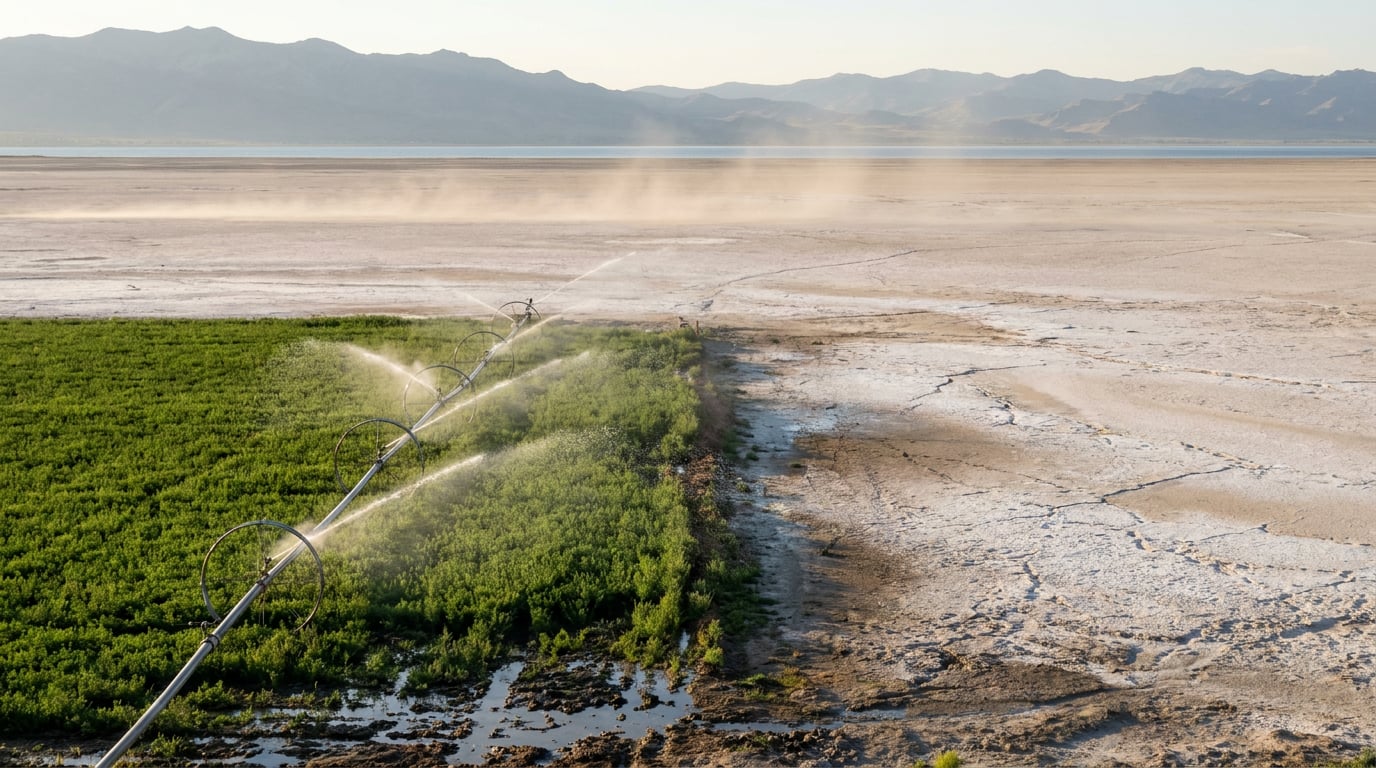
What does an acre-foot of water earn in a Utah alfalfa field?
At 2025 hay prices, about $180 a year over the out-of-pocket costs of growing it. Once you also count land rent and equipment, it’s somewhere between nothing and about $65.1 That’s not a knock on farmers. Hay prices fell from $297 a ton in 2022 to $174 in 2025 (USDA NASS). Margins are thin right now.
But that number leaves something out. Every acre-foot a field uses up is one that doesn’t reach the Great Salt Lake. From 2020 to 2024, farms accounted for about 65% of the water people used up in the lake’s basin. Cities and industry used about 27%, and the mineral companies on the lake about 6% (Great Salt Lake Strike Team). Most of the farm share is hay. In the state’s 2026 farm water study, alfalfa and grass hay used up more water than every other crop in the basin combined, about two-thirds of the farm total by my read of its chart (Utah Division of Water Resources, 2026). The lake is sending us a bill.
The bill
The lake was about seven feet below a healthy level at the end of the 2025 water year (Great Salt Lake Strike Team). As it drops, it exposes lakebed. About 70 square miles of that lakebed are already active dust hotspots, and that could grow to 187 square miles.
In February the state put a price on controlling that dust. For today’s hotspots alone, it estimated $3.2 billion to more than $31 billion over 50 years, depending on the method (Utah Division of Water Resources, 2026). The report also points to keeping the lake up as a way to avoid much of that cost.
So here’s the distinction I keep coming back to. There’s what water earns a farmer and there’s what using it up costs everyone else. The first number is small. The second one is large, and nobody’s paying it yet.
Not a free market
I lean toward free markets. I think people make good choices when prices tell them the truth. And that’s exactly the problem here. The price of growing hay in Utah doesn’t include the lake.
When a cost lands on someone who isn’t part of the deal, economists call it an externality. A factory that dumps into a river can sell cheaper than one that cleans up after itself. That’s not the market working. It’s the market missing a cost.
Utah alfalfa is in a similar spot. It isn’t that farmers are doing anything wrong. They’re following the rules and the prices in front of them. The prices just don’t include the lake, because the lake barely has a seat at the table.
Farmers aren’t the problem
It’s easy to blame the people growing the hay. The numbers don’t back that up.
When the state studied what it would take for alfalfa growers to stop irrigating for a season, its model landed on about $236 per acre-foot (Utah Division of Water Resources, 2026, prepared by USU, Jacobs, and M.Cubed). That’s a little above what hay earns over its out-of-pocket costs. Farmers aren’t confused about what their water earns them.
And a water right is more than a hay crop. It’s collateral at the bank. It’s the retirement plan. It’s the reason a kid can come home and farm. Nobody should expect a family to give that up for free.
Give the lake water shares
The market answer is to treat the lake like any other water user and give it water shares. Utah law already allows it. A state division can buy, lease, or accept water rights and put them to use on sovereign lands (Utah Code 73-3-30), the land under navigable waters like the Great Salt Lake (Utah Code 65A-1-1). The state’s Strike Team describes the same idea inside a canal company: make the lake a shareholder that gets its deliveries like everyone else (Strike Team).
Shares matter because of how Utah hands out water. Rights are filled by priority, oldest first. If a farmer leaves water in the river, it doesn’t go to the lake. It’s open to the next right in line (Utah Division of Water Rights). Saved water only gets to the lake for sure if the lake holds the right to it.
This isn’t the same as giving the lake top priority. That would push senior farmers to the back of the line without paying them. With shares, the lake stands in line like everyone else, with the priority dates of the rights it holds. And every acre-foot the lake holds is one the rest of the basin can’t use up. That’s the limit. If a new subdivision or a new field wants water after that, it buys from someone who already has it.
Once the lake holds water, the bill shows up in the price. Water gets scarcer, so it’s worth more. A farmer who keeps growing hay is choosing to use water that someone else would pay for. A farmer who sells or leases it gets paid. Hay has to compete with every other use, and in a lot of places it won’t win.
Is it worth it? Here’s a rough check. The state’s Strike Team modeled two futures. Adding 250,000 acre-feet a year still leaves the lake in the danger zone. Adding 800,000 a year brings it back to a healthy level by 2055 (Strike Team). Full-season alfalfa uses up about 1.5 acre-feet an acre. So 250,000 acre-feet is about 167,000 acres of alfalfa, roughly a third of the 480,000 acres Utah harvested in 2025 (USDA NASS). 800,000 is about 533,000 acres. That’s more alfalfa than Utah grows, and some of it grows outside the lake’s basin. So the bigger number can’t come from hay alone. Lawns have to be part of it. Watering lawns in the basin used up about 408,000 acre-feet in 2024, a quarter as much as all of its farms (Strike Team).
If every acre-foot cost what the state study found for farm water, $236 to $340, that’s roughly $60 to $85 million a year on the low end and $190 to $270 million on the high end. Spread over 50 years, controlling today’s dust runs about $64 million a year for the cheapest method, plowing the lakebed, which has to be redone every few years. The most expensive is about $620 million a year. And dust controls only treat the symptom. So water for the lake isn’t cheap, but it’s in the same range as the cleanup, and it actually fixes the cause.
How the lake gets its water
Buying a few thousand acre-feet at a time and hoping it adds up won’t get us to 800,000. Someone has to use less, on purpose and at scale. Here’s how I think that actually happens:
- Buy old rights. Priority goes with a water right when it changes hands. That’s why senior water sells for more. In the Cedar Valley, outside the lake’s basin, a 2025 appraisal put the oldest rights at $19,000 an acre-foot and the newest at $2,500 (Hymas appraisal). The lake doesn’t have to wait for its rights to get old. It can buy rights that already are. The state’s new lake leasing program is already told to favor senior adjudicated rights (Utah Code 73-34-301).
- Lease the back half of the season. In the state’s study, stopping alfalfa irrigation after June 30 cost about $235 for each acre-foot saved, and the field still made a little over half its normal hay (Utah Division of Water Resources, 2026). The farm keeps farming. The lake gets the late-summer water.
- Rotate the fallow. Sign long contracts where a slice of the enrolled ground rests each year, the way Palo Verde does in California (more on that below). The buyer gets steady water, and no single farm or town dries up.
- Bank it. Under Utah’s water banking law, water put in a bank is protected from forfeiture and can be leased out, including to keep water in streams. But the law is a pilot, and it sunsets in 2030 (Utah Division of Water Resources).
None of these gets there alone. Together, with cities cutting back on lawns, they’re a plan.
At first, most of the buying will be public: the state, donors, and the lake’s mineral and brine shrimp industries. The state has already started, with $200 million for farm water optimization in 2023 (Strike Team). That’s a real bill. But it’s smaller than the dust bill, and it buys back a lake instead of a cleanup.
The rest is hard too. Someone has to decide how many shares the lake needs and measure what each field actually uses up, not just what it diverts. The lake’s water has to be protected all the way down the river, or the next user downstream just takes it. And once the lake holds water, everyone else’s water is worth more, so deciding who sells first will be a real fight. I don’t have those answers. But I’d rather argue about them than keep pretending the lake is free.
What makes sense to grow here
I don’t think the answer is no hay. Utah had about 90,000 dairy cows and 335,000 beef cows as of January 1, 2024 (USDA NASS). Hay is heavy and bulky for what it sells for, so hauling it a long way gets expensive fast.
So why not trains? Some hay already rides them. Export hay gets pressed into shipping containers and sent by rail to West Coast ports. Before southern Idaho got its own rail terminal in 2021, one Idaho hay company was trucking about 80 containers a week to Salt Lake City to catch the train (Idaho Farm Bureau). But cows aren’t on rail lines. Hay headed to a dairy still needs a truck at each end. In a 2004 Washington State study, farmers shipped none of their hay by rail, and about two-thirds of their alfalfa went by truck straight to livestock farms (Washington State University). So some hay should keep growing near the cows that eat it. If Utah grows less, local hay prices will go up, and dairies would feel that.
But once the lake holds water, the question “how much hay should Utah grow?” stops being a political fight. The cost of a shrinking lake starts to get priced in. Hay grows where it still pays with that cost included.
Growing towns are another buyer. Utah keeps talking about new pipelines. The Lake Powell Pipeline was estimated at $1.3 to $2.2 billion in 2020 dollars (LPP). Leasing water from willing farmers could be cheaper for some towns, and it keeps the money in rural Utah. I think a version of this idea could help save Lake Powell too. That’s a piece for another day.
What gets in the way
Even with the lake holding water, the market has to actually work. Right now it barely does.
Use it or lose it. A water right left unused for seven years can be forfeited (Utah Code 73-1-4). There are exceptions for leases and for approved conservation fallowing. But the fear is real, and hay is the easiest way to prove use.
Moving water takes a long time. A change in how water is used needs state approval, and neighbors can protest. In one case I found, an application took 688 days (Division of Water Rights). Utah’s water banking law makes short-term leasing easier, but it’s still a pilot.
Shares are tied to the ditch. Most of the water diverted in the basin belongs to irrigation companies, and a company has to keep enough water in its canal to reach the last farm on the line (Strike Team). So one farmer leasing water out can leave the ditch short for everyone else. Leases work better when the whole company takes part and the lake gets its turn like any other shareholder.
The tax rules lean one way. Greenbelt taxes farmland on what it produces, not on its market value. That’s reasonable, and a lot of families depend on it. But leaving farming can trigger back taxes.
What this can cost
Water markets have hurt rural places before. Los Angeles bought up land and water in the Owens Valley a century ago and dried much of it out. In Crowley County, Colorado, cities bought so much farm water that by one count fewer than 5,000 of about 50,000 irrigated acres are left (Western Landowners Alliance).
There’s a gentler version. In Blythe, California, landowners in the Palo Verde Irrigation District fallow in rotation on about 26,000 enrolled acres, paid by the Metropolitan Water District of Southern California. They’ve done it since 2005 (Reclamation). Families keep their land and rights. No single town dries up, and the buyer has put money into the valley too (Metropolitan). It works because there’s a big buyer at the table. With its own water shares and steady money behind it, the lake can be that buyer.
What I’d change
- Give the lake enough water shares to keep it alive, and let everyone else trade for the rest. This is the one that matters most.
- Buy old, lease smart. Favor senior rights, split-season leases, and rotating fallow over one-off deals.
- Use it, lease it, or sell it. Don’t take rights away. But if water sits unused for years, offer it through a state water bank instead of pushing farmers to grow hay just to keep it.
- Make leasing easy. Make water banking permanent, put clear timelines on approvals, and let water be leased to the lake as easily as to a city.
- Let shares move fairly. Lease through whole canal companies where we can, and have shares that leave help pay the ditch costs they leave behind.
- Treat land choices evenly. Keep greenbelt, but don’t let back taxes decide what a family grows.
Where I might be wrong
I’ve never farmed, and this is my best attempt at the math. If you farm in Utah, I’d like to know what I’m missing, especially what a lease or share sale would have to look like before you’d take it. I’ll take corrections seriously and update this piece where your numbers beat mine.
Footnotes
-
Using the University of Idaho’s 2025 eastern Idaho alfalfa budget, the closest current budget I could find, restated to Utah’s 2025 yield (4.3 tons an acre) and price ($174 a ton) (University of Idaho, USDA NASS). Each figure is divided by the 1.5 acre-feet the state uses for full-season alfalfa depletion. Over operating costs alone, hay earns about $180 an acre-foot. After Idaho’s land rent of about $210 an acre and other full costs, it’s near zero. With Utah’s average irrigated rent of $114, it’s about $65. USU’s older 2019 Utah budget gives about $100 at 2025 prices, but I couldn’t confirm how it treats land (USU Extension). There’s no current Utah budget. ↩